Posts tonen met het label AI. Alle posts tonen

zondag 15 oktober 2023

On the role of AI in Research and Science: Not Giving Fish, but Teaching to Fish

Ever since Alan Turing's groundbreaking paper on artificial intelligence, we've been on a quest to master what he aptly described as an "imitation game." AI advancement is a continuous endeavour to increasingly simulate and mimic human reasoning and behaviour, an extension of the mediaeval ambition to build a "Golem", a mythical non-human but anthropomorphic, non-machine but mechanical, incarnation that simulates and ultimately surpasses our own capabilities.

While building a passable imitation of human behaviour is commendable, it carries the inherent risk of equally amplifying our built-in limitations and flaws. We want to marvel at the astonishing feats of AI, but do so without the risk of being confronted with equally glaring examples of human shortcomings.

We've witnessed glimpses of AI gone astray due to biassed training or unforeseen behaviours. Image recognition AI might hallucinate recognizable patterns in random noise, and online language models have at times produced convincing but utterly false information without even the most basic fact-checking or self-questioning.

Historically, science attributes human failures to a lack of knowledge, and the scientific process establishes a structured dialogue to rectify this. This dialogue, while imperfect, is fine-tuned to cultivate knowledge—a shared, common understanding of reality that enables us to predict the outcomes of our actions and policies. It has also unveiled our inherent biases: our tendency to disregard unwelcome facts, seek arguments that align with our preconceived notions, and engage in post-rationalization, all while using notoriously ambiguous language.

Today's challenge lies in aligning the statistical prowess of AI with the perennial quest for knowledge. Obtaining quick answers does not equate to fostering understanding, but they should harmoniously coexist.

(Data) Science has progressively embraced the principles of the semantic web and semantically unambiguous knowledge graphs. The deceptively simple RDF grammar, with its concise three-word sentences, has introduced a new computer language aimed at describing facts about the world, this in contrast to the directive nature of classic programming languages (Turing-complete instruction sets)

This transition to publishing linked open research data brings forth a global effort to define vocabularies, unambiguous reference terms, and navigational property paths that connect disparate parts of a scientific knowledge graph spanning all domains. The grown consensus behind this forms the semantic backbone for fruitful collaboration with AI, equipped with advanced statistical analysis capabilities.

The collaborative cycle unfolds as follows:

  • Humans provide curated real-world data encoded in semantically annotated form (triples).
  • A "feature-detecting AI" can be trained to assist in accurately converting new, high-volume observations into semantically precise statements.
  • The expanding interconnected data becomes accessible for both humans and AI to derive meaning from it.
  • A distinct "association-detecting AI" mines this extensive and domain-spanning dataset, revealing surprising statistical connections that are, crucially, unambiguously understandable due to shared terminology.
  • Some of these discoveries trigger our attention, becoming new hypotheses for which experts, likely humans initially, devise data collection systems and theories to verify or debunk them and, ideally, ascertain the direction of causality.

In prehistoric times, a hunter would assess various factors like prey movement, distance, and wind before throwing a spear to secure a meal for their tribe. In the modern perspective, this is an exquisite solution to second-degree ballistic functions. Individual experiences and skills are explained as theories, signifying reusable knowledge. In the "survival game" this approach has unlocked a new level to us humans.  We should not nonchalantly hand the keys to this over to a new breed of intelligence. And, if further down the road, AI is to help us discover more new levels, we must establish and govern the principles that allow us to keep evolving alongside it.

woensdag 10 april 2019

A bots license to kill.

This is a lengthy reaction to FLI Podcast: Why Ban Lethal Autonomous Weapons?
(LAW == Lethal Autonomous Weapon)

First off: thanks to the makers for the insightful podcast. Even if it made me cringe often, it also made me question, rethink and better argument my own believes and concerns in this area.

However... :)

There are three elements I strongly missed, or rather, I oppose three implicit assumptions that seem to be unquestionable:
  1. why weapons
  2. why robots vs humans
  3. why not consider to promote

In reverse order:

Where are the opposing views? 

While I consider myself on the "ban"-side, I really miss an honest investigation into what benefits there are. What could we gain from having access (even massively) to these LAWs?
Seriously:
  • These life-death decissions, and their executions really look like one of those "dirty jobs" we'ld hapilly be ofloading to autonomous systems, right? Less stress for humans, less strain on humanoid conscience, ...
  • Humans are known to be error-prone. Doubly so when in stressful situations. There is no reason to see this as a benefit. When considering that single case of (only human possible) mercy, we are probably ignoring the ten unneaded victims he made.
  • Everyone having one of those LAWs might sound horrifyingly distopian, but it also kind of "leveling the playing field", better avoiding power-imbalance, distributing potential use of (protective) lethal violence more evenly. In this (utopian) view we all get to be assigned a robotic guardian angel, one to be reckonned with. Hell, yeah!

Better examples to be found; but in any case: I really think AI is in the corner of "large potential benificial progress" - I fail to see the a priori reason why this could not also be in the area of managing, controlling, countering, balancing lethal violence.
-oOo-

The strange case of two distinct ethics

Again and again I am puzzled by this artificial (and once more: upfront, unquestioned) divide between robots and humans in ethical questions. I understand these robots are new, and obviously not-human. With their development new ethical questions arise, new insights are to be found. But these are to be extensions, completions, adaptions of whatever ethics we already have: there is no second set of ethics to consider. This is about us.
I've written at length about this on my blog-series on ai-ethics: Turing's mirror - Turing's Duck - Turing's Razor
To me the separating screen in Turings test really functions as John Rawls' "veil of ignorance" or the blindfold on Lady Justice: "What if we didn't know if it was a man or a bot?"

So for me, unwilling to make a priori human vs bot distinctions, this podcast made a threasure trove of cringeworthy moments. Almost each time the 'human' is explicitely mentioned:
  • When "human dignity" is considered - as if the value of one's life is measured by the way it is taken away.
  • When killing robots are said to "dehumanize war" - as if man needed help to do that, really?
  • When we seek "meaningful human control" - as if we really trust humans?

As an aside: I live in Flanders, Belgium, near the visible remains and memory of the devestation of world war I. Maybe the CCW should have be held over here, in stead of in Geneva?

I loved the "do no harm" approach. But when it comes up, it gets to be the prerogative of the "medical community" (some special brand of humans?). Why is this not considered the core of the more broad "human nature" (military and law-enforcement communities included). And if so, why would this not naturely be expanded to a "universal guiding principle" that also drives and governs automates?

In our own history we continue to abuse abstract devisions to separate, to blame, to dehumanize, to oppress and finally to kill. Let us stop now. AI challenges should help us overcome differences and devisions between humans; let us not need one more distinction to achieve that.
-oOo-

LnAWs

So obviously. I find it awkward to hear fifty minutes of talk about banning lethal autonomous weapons, and just take for granted: the natural existance of lethal non-authonomous weapons.
Whatever rules we have on the latter, should naturally be extended and applicable to these new ones. And if the new ones make us reconsider: it must be because we hadn't thought well enough about the old ones in the first place? (No, I'm not baiting for NRA style reactions. This is not about the US)
Our current approach to lethal weapons shows we can be organisationally realistic and legislatively optimistic at the same time.
Legislation already states "You should not kill". Still we understand bad sheep will emerge, so we introduce 'law-enforcement', a state organized monopoly on violence to be used to avoid greater harm / more violence. This tends to work. The strange thing is: we know individuals within the law-enforcement fail. Apparently this proclaimed "meaningfull human control" is not flawless. This shows our trust does not go towards those individuals, but to the institute.
We are in fact *not* looking for individual human control, we are satisfied with an organizing controlling-society. A society defining and adjusting the policies and rules of engagement. One that supervises and reports back on actual execution. One that disciplines the abuse of trust. One we are part of ourselves.
-oOo-
To close up: I really think (paradoxically) that calling to "Ban LAWs" is the worst possible strategy at achieving a ban on LAWs. (or rather LWs of any kind)
In dossiers like this (strong opposing ethical matters of principle) the solution never comes from those digging-in or standing their ground. Not from those declaring their views as "non negotiable". In this case I would expect more practical result from carefully leaving the high moral ground towards a negotiable position of some objectively verifiable test. From changing the narrative from "Never cross this line" to "Ok, but only if it passes this level".
You might of guessed: In my world-view passing that very test that makes any law-enforcer deserving of "our (society) level of trust"; that test should be applicable to both man and bot. If we end up in a future where we can gradually raise the bar in that test, we should consider that a good thing. Even if those levels grow to be achievable only by 'them'.
One might recognize in this strategy the vague reflection of what Turing did in his paper "the imitation game": Facing the claim that "computers will never be intelligent", he simply made 'intelligence' into a falsifiable assertion: an objective test. By hiding the nature of the participants behind the screen, he left the a priori principle that it (intelligence) could not be achieved by one of them. In return we got into an interesting race of "ever better".

-oOo-

This comment displayed some agency in stubbornly requiring publication here, to balance the irony and frustration of getting killed off (i.e. marked as spam, probably for containing a perfectly valid URL) by, surely, a robot!


donderdag 19 april 2018

Turing's Razor


Robot ethics should be an extension of human ethics; and why that means we should urge programmers to simply neglect implementing trade-offs inspired by the trolley dilemma thought experiments.

Some months ago I wrote about robot vs. human ethics:

  • Turing’s Mirror: How robots make us look into the mirror. To realize that ethical robot questions are really centered around our own morals. Reflecting our own continued failure to lead by example in a landscape shaped by power imbalance.
  • Turing’s Duck: How the essence of the imitation game equally applies to ourselves. How we too just learn to pretend and to conform to expectations. Leaving ample ground for our infamous hubris.

Since then I've been struggling with this third one.  Pondering around what emerges like some guiding principle in these topics. Such "decision guides" deserve being formulated as ‘razors’, like the infamous ones from Occam or Hanlon.  And being the origin of my inspiration, the obvious choice is to name this one after hero Alan. All while happily giving in to the stylish fit of making a sequence of three 'Turing' blog titles :)
Image credits : Jeff Osier-Mixon. CC BY-SA 4.0

Here is what I’m calling “Turing’s Razor” :

Do not ask robots to achieve ethical norms no human needs to adhere to.

Some derived versions spontaneously sound like:

Do not blame on technology what humanity has successfully mismanaged for ages.
Don't attribute to technology those moral failures we humans couldn't resolve (without it).

And it leads to this obligatory corollary:

Stop it already with endlessly letting those meat-brains get off the hook when artificial brains show a path to doing it better.

With one eye on this shiny new compass, we should be able to navigate this modern age landscape, avoiding the steep cliffs of false ethical questions.

-oOo-

No way back

Before getting deeper though, it should be clear that there is simply no way to avoid thinking about these issues.

Take for instance the discussion on DNA Databases.  Obviously this gets condemned as too strong a violation on our public rights, freedom and privacy. Still, there should be room for the careful progressive approach: if current state of legislation, practice and lack of transparency urges us to strongly oppose, than do so, but also start thinking about the right way to do it. You want to be ready for that time when this does become allowed practice: did you spend all your energy strictly at opposing, or did you, in the meantime, also craft up the process to correctly supervise the usage? Principles are useful, less so: being blindly principled about them. Finding a good set of regulations to control possible but avoidable mistakes really is due.

The cry to return to happier times when these questions played no role is a false one: There is simply no ‘undo’ to progress. Once escaped from pandora’s box we just have to reckon with every possible fringe abuse of even the most benign invention.
The other extreme is equally untenable: “To abandon all regulation so not to inhibit 'Future' itself along its disruptive path.” No, we can do better than just hoping for the best. Guard the balanced outcome for all involved.

Both extreme visions will accuse the other side of being overly naive, while neglecting that both are entangled in a race in naivety. The useful cases are born in the same nest as their evil twins, the fruitful trees seeded amid the tares: careful weeding is a balancing act requiring attention. Controlling the usage must be separated from prohibiting the technology. The boundary between the beneficial and the dangerous is too thin to use anything else than the sharpest lancet. So, lay aside your sledgehammers.

We have been here before, at least if you can believe Ash Carter in "What I Learned from the People who Built the Atom Bomb"

I'll give you a topic...

Checking how well this new razor actually shaves requires searching for a suitable beard: What about lethal accidents of self driving cars?

This topic has been covered more than just a bit. Quite a challenge to find anything to add to what is already in the mix. Some references to get up to speed:


Some of those reference the trolley dilemmas; some take that down to the grim boundaries of "counting lives" (which made me think of this old Chernobyl documentary); some succeed in considering this as non-harmful practice, even beneficial and necessary, as it resembles (almost) the practice of medical triage; some strongly aim for the pragmatic "don't let the perfect be the enemy of the good"; some call upon society to "at least ask the right questions?'; some just have the Frankenstein Reflex written all over (term coined by Isaac Asimov); some arrive at the conclusion that "robot ethics should be a natural extension of human ethics". But none of them listened to grandma.

Best effort

Grandma assured us over and over: "It never hurts to do your very best." Applying Turing's razor we should investigate first what our reaction is to failing human drivers. Particularly those who pass grandma's test with flying colors (i.e. didn't do drinks nor drugs, slept enough, kept themselves and their car in shape, adapted speed to circumstances, kept attention on the road, not on media device, etc... ) If we can allow some of those to actually get off the hook, and be pardoned by admitting there was no possible better outcome; that whatever horrific turnout can be mildly covered under the cloak of "just bad luck", … if so, then why would we not be able to come to the same conclusion for robots? Or their programmers?

I admit that pulling in the trolley dilemmas starts from a defensible position: after all: good prevention, like good robust programming is all about considering "what if" scenarios to a large extend.  Passed that initial outlook of logic it took me quite some time to see how this line of thought unwittingly opens the door for something else to sneak in. Two things in fact.

  1. for the robot: We silently extend the check-sheet for evaluating his 'very best' driving skills.
  2. for the coder: We ignore that doing his 'very best' plays in a different realm.

Doing your best driving around safely does not overlap at all with being the best moral judge in split-second valuation of fellow human beings.  If it would, getting a driver's license would include obligatory passing university classes in advanced ethics, moral judgement and human potential assessment. Why do we now add this in the mix? Is this just because we (think the robots) can? Are we so satisfied with predicted safety levels of self-driving cars that we think it is (ever) good enough? So good at least that doing your best at pure safety and avoidance will reach some limit, after which it gets redefined to finding the best trade-off? Or is that giving in to mediocrity? Let me tell you this: Judge "grandma" will be less than pleased with a robot explaining it dedicated part of its processing power to evaluating and counting lives rather than strictly avoiding all possible harm to the fullest of its ability.

But where to shift blame? Since we don't know yet how to prosecute and sentence robots themselves, the programmers suddenly show up in the crosshairs. They can make judgments, right? They can negotiate trade-offs. They can agree on a set of moral rules. They too have to do their best. I agree, but we should notice that they play on a different level.  They're not the ones driving, they are coding. Coding is policy making: defining the rules of engagement that will eventually be executed. We have a different set of standards for those.
The trolley-equivalent of their role is that of the railway-security-engineering team, and it is simply not present in the trolley dilemmas. The questions they are solving would be: How could any person ever end up on a track where trolleys pass? How do we avoid that unsupervised bystanders are operating our switches? How to design security fences on all bridges to keep (even fat) men to drop down from them? Admittedly, the execution of this job does involve trade-offs, balancing and what-if scenarios. But doing your 'very best' in this realm assumes neutrality, removing all possible personal bias, extracting generic strategies out of specific cases, aiming for statistical overall best performance. It too refrains from valuing individuals and counting lives. Acceptable policies are as blind as Lady Justice. Good performing policies are designed to do equally well regardless of the person involved.

Thus programmers are relieved from coding in trolley-like (case-based) ethical decisions, and the robots are relieved from negotiating which people get to live. Their common guiding principle becomes the one we've known for ages: "do your very best to do no harm". Zero tolerance on making any victims.  Such principle becomes a clear instruction towards programmers, one that should get them to feel proud about any invention they add towards that goal. More beer and pizza to them!

-oOo-

Bad luck

If we all keep doing our best the failure count will go down. Nevertheless, remaining cases will exist. And so returns the notion of "bad luck".

Most likely this will hit hard with the paradox of "totally unacceptable improbability". The lower the chance that something bad happens to me, the more unacceptable that becomes. Why me? This must be intentional! Who is behind this?  The better these robotic drivers become, the less prepared we will be to accept the remaining fatalities as ill-fated.
Consolation (probably less so for those directly involved) comes from knowing that these versions of "bad luck" no longer should be "in vain".  Each specific failure will end up being analysed and turned into fixing the policy - I meant the code -  when ready: instantly deployed, not to happen again.

We know how to do this, since we have such procedures in place for dealing with accidents in air traffic.  Whatever the reasoning behind it: We seem to apply these analyse-to-remediate procedures to larger extend as the transportation mode is more automated or mechanic. Considering Turing's razor we should question this strange, unmotivated privilege towards those ape descendants.

One more thought, in a desperate attempt to avoid receiving the label of devout dataïst or naive futuroptimist.

Maybe, just maybe, the only way for us humans to really trust these robots, is for them to be as failure-prone as we are?

-oOo-

This article is part of a series: Turing's mirror - Turing's Duck - Turing's Razor


update: I came across this quote attributed to Arthur C. Clarke. It says it all.
One cannot have superior science, and inferior morals.
The combination is unstable and self-destroying.
– Arthur C. Clarke
update: Found this project "The Moral Machine" at MIT for measuring what humans generally think should be done in certain traffic-dilemma cases.  While this is a great idea for measuring how humans think about these cases, it remains totally unclear why that corpus of facts would be a good/reliable source or guiding design principle for actually engineering "automated" safety.  We should aim higher then opt for that variant of failure that will be mostly acceptable by humans. We should stop thinking like lawyers about the blame shifting, and more (like engineers?) about doing things better. I still think Arthur's quote is right on, just make sure your morals team understands the science.

maandag 26 maart 2018

AlphaGo, The Movie - Waarom ik ga kijken.

AlphaGo Movie Poster
Op 23 april 2018 wordt in Cinéma Sphinx in Gent, als afsluiter van een reeks robot-films,  de documentaire "alphago" getoond. Alles in een bijzonder fijne samenwerking met IDLab van Ugent, GentM en het Gentse Go Genootschap. Om jullie over de streep te trekken om af te komen beloof ik bij deze plechtig om nooit meer - ook de avond zelf niet (dat wordt tong afbijten) - onderstaande riedel af te steken. De hoe en waarom van mijn passie in het samenvallende brandpunt van hobby (GO) en interesse (AI).

Lees het misschien toch eens. Maar vooral: keihard gaan kijken!
Dit is bijna net helemaal niet de kortst mogelijke versie geworden van mijn gedachten hierover. Wie enkel op zoek is naar voldoende context en goesting voor de film zelf kan beter de teaser opvissen op de pagina voor de aankondiging en tickets. Of scroll door naar de trailer een beetje verderop.
Er zijn trouwens ten overvloede wat nerderige details in dit verhaal. Die zijn natuurlijk onderwerp van uw spontane reflex: zijnde overslaan (de ene) of betweterig verbeteren (de andere). Voor het gemak van beide groepen staan ze achteraan als voetnoten verzameld.

Wat verwacht je van de documentaire.

Veel.  Spanning al zeker. Uiteraard het soort voorspelbare spanning van historische films als ‘Pompeii’ en ‘Dunkirk’: Je hoeft je niet echt af te vragen hoe het afloopt. Toch vermoed ik dat de toevoeging van menselijke emotie, persoonlijke verhaallijnen, tussenliggende overtuigingen, misvattingen, doorbraken, falingen, gemiste deadlines, en een goede klankband ook hier de onwaarschijnlijkheid van het behaalde doel in de verf zetten.

Dus ook te verwachten: dat vleugje ‘the underdog wins’ van de klassieke sportfilm. Afgezet tegen het menselijk drama: Lee Sedol, strijder voor de eer van de mensheid, de gedoodverfde winnaar en zijn gedwongen transitie naar sportieve verliezer. Geserveerd op een bedje van eindeloos respect en etalage van zijn lef, inzet, toptalent en kunnen. In dezelfde sfeer ook rolt de aftiteling straks vast over een opgebouwde piek aan optimisme heen: jubelend om wat we als mensheid kunnen bereiken. Ik weet even niet of ik het wel droog hou.

Voor mij en vele anderen zit er ongetwijfeld ook het plezier van herinnering en herbeleving van vijf keer heel vroeg opstaan in maart 2016 om de spelletjes live te volgen.  De verbazing van toen nu kunnen aanvullen met details uit een blik achter de schermen. Lekker.

Content als een spinnend katje opgerold bij de kachel. Popelend als een jonge merrie, de rug rollend in het lentefrisse gras. [*]


Wat er aan vooraf ging. 

Computerspelletjes (of computer-varianten van echte spelletjes) zijn gedroomde speeltuinen om Kunstmatige Intelligentie (kortweg AI) te kweken en te testen. De redenering vertrekt van intelligentie bekijken als het potentieel om te overleven in een wereld vol ondoorgrondelijke uitdagingen. We vinden onszelf als mens namelijk nogal wat op dat punt: We hebben toch maar mooi onze weg gevonden in een wereld waarvan de regels niet netjes vooraf in de bijsluiter zijn meegeleverd (fundamentele fysica om maar iets te noemen); we hebben als uitbreiding van de ons ingebakken overlevingsstrategie een aanzienlijk corpus aan kennis opgebouwd; we geven dat aan elkaar door terwijl we er blijven aan sleutelen.  In die visie zijn spelletjes vooral kunstmatige (vereenvoudigde) werelden waarvan we de complexiteit kunnen bepalen via de regels die er gelden. De mate van bereikte intelligentie (ie dus potentieel om te overleven) valt er ook gemakkelijk af te lezen aan de behaalde score, winst of verlies.  Voor onderzoekers dus een dubbele bonus: schaalbare complexiteit van simpel naar altijd maar reëler, én een ingebakken score waarmee je succes meet. Het zou best kunnen dat spelletjes daarom ook nuttig en populair zijn in de opvoeding van onze mensenkinderen.

Redelijk snel slaagden automaten erin de eenvoudiger prooien uit de speeldoos (boter-kaas-eieren en dammen) naar hun hand te zetten. Daar lag niemand echt wakker van. Boeiend werd het toen het spelletje in kwestie voor de mens zelf een uitdaging vormt. Toen in 1997 de IBM computer "Deep Blue" in New York (na de in 1996 mislukte eerste poging in Philadelphia) won van de toen heersende kampioen en schaaklegende Kasparov was dat niet minder dan wereldnieuws.

Op die dag was er gelukkig nog “Het Chinese bordspel Go” als geruststellend onbereikbaar eiland: "Dáár zijn de mensen wél nog veel beter in"; voor de onderzoekers werd het meteen de volgende te halen scalp aan de riem.

Vanwaar die magie van Go?

Go is niet alleen duizenden jaren oud, het is in een groot deel van de aziatische wereld ook vandaag ontzettend populair.  Het wordt makkelijk vergeleken met schaken (van bij ons).  Zoals het een goede vergelijking betaamt loopt die op veel punten mank. De culturele impact en positie van het spel is ginderachter vele keren groter dan wat wij, westerlingen, vermoeden op basis van het eigen schouderophalen bij de exotische buur of kennis die zijn kinderen wél naar de schaakclub stuurt.  Die stevige culturele bodem komt trouwens mee aan tafel met een flinke stempel aan etiquette-regels die rond het spel leven.
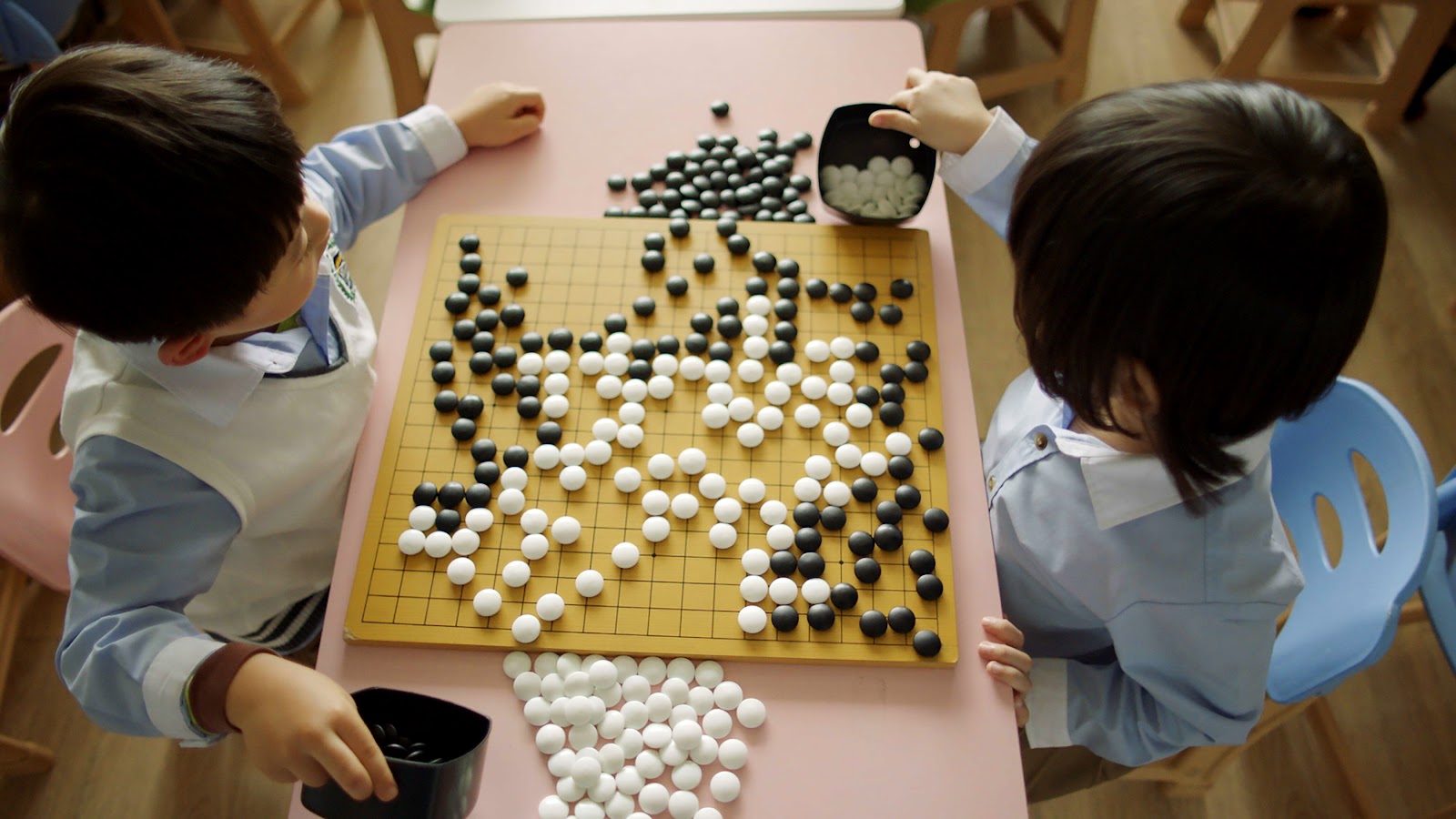
Two children playing Go - Movie Still
Alphago Movie Still - courtesy Google DeepMind and Roco Films Educational
Wie zoekt naar kunstmatige strategieën om dit varkentje te wassen ontdekt snel de andere mankementen in de vergelijking.  De complexiteit van Go overstijgt die van schaken met vele grootteordes.  Dat getalsmatig uitdrukken gebeurt vaak via het tellen van het totaal aantal mogelijkheden: Van Go wordt gezegd dat het spel meer mogelijke spelsituaties kent dan er atomen zijn in het universum. [1]
Maar daar begint het probleem pas. Niet alleen zijn er véél spelsituaties te overwegen, de inschatting van elk ervan "Is dit gunstig voor mij of voor de tegenstander?", is steeds onzeker.  Bizar als je het vergelijkt met schaken, want het eindresultaat in Go is absoluut duidelijker: winst of verlies zijn de enige opties; aan pyrrusoverwinningen als remise en pat doen ze niet mee. Maar alle situaties vóór 'the end game' zijn niet in een eenduidige getalwaarde te vatten.  En dat maakt het een onmogelijke zoektocht: Waar is het verborgen pad van zet en tegenzet dat je kan leiden van waar je nu bent, naar de situatie waar je wilt eindigen: winst! [2]

Je voelt zo de paradox: de go spelregels zijn eenvoudig en elegant.  Uitgelegd in de tijd nodig om alleen al de verschillende schaakstukken te herkennen. Precies die bedrieglijke eenvoud schept een virtuele wereld waarin ontzettend veel meer mogelijk is; waar meer afgeleide kennis te ontdekken is; waar de schat aan overgeleverde speel-strategieën onbewezen, dus aanvechtbaar blijven; waar nuance en balans de codewoorden zijn; waar elegantie, eenvoud, en intuïtie regeren; waar besprekingen zijn opgetrokken uit metafoor en poëzie.

Google vs Facebook

De recente geschiedschrijving van ‘de aanvallen op het kraken van Go door automaten” geeft uiteraard de grote IT bedrijven hun rol.  Zo was er begin 2016 de beloftevolle aankondiging van Facebook. Hun inzicht was om de opgedane kennis van gezichtsherkenning in te zetten om de structuren en patronen voor winst en verlies te herkennen.  Niemand wist dat ondertussen een klein bedrijfje uit Londen, slim opgekocht door Google, reeds een veel belangrijker mijlpaal in die wedstrijd had behaald.

DeepMind ging in die periode al over de lippen. Ze toonden behoorlijk indrukwekkende resultaten in een onderzoek naar een AGI.  Die afkorting laat zich lezen als een AI met ambities richting de G van Generiek. Een kunstmatig brein dat inzetbaar is los van het specifieke probleem (de virtuele wereld) waarvoor hij is ontwikkeld. Hun claim to fame: één dergelijk AGI systeem dat, na onbevangen rondlopen in de verschillende werelden van de klassieke Atari games (space invaders, pong, break out, …) zichzelf leert om te overleven in elk ervan, op niet minder dan bovenmenselijk niveau.

Dat ondertussen in november 2015 ook de Europese Go kampioen Fan Hui van een eerste versie van alphago een droge 5-0 aan de broek kreeg gesmeerd bleef onbekend tot hun wetenschappelijke paper erover verscheen begin 2016. Complete verrassing. De meest optimistische AI volgers (ik beken schuld) hadden nog net hun verwachtingshorizon bijgesteld van het gangbare ‘over tien misschien’ naar een hoopvolle ‘vijf’ jaar. De deep-mind-paper maakte die inschatting meteen onnodig conservatief.  Plots stond dit doel binnen het tijdsbestek van één of twee jaar op de agenda.

Zo ruim bleef die inschatting wel; ze werd ook niet bijgesteld na de aankondiging van “The DeepMind Challenge Match”. Hun eerste topwedstrijd met de legendarische Lee Sedol had een duidelijk aura van jeugdige overmoed.  Dat zou volgens zowat iedereen het equivalent worden van de schaakles die Deep Blue in Philadelphia ‘96 kreeg geserveerd.  Die geruststellende gedachte werd mee gedragen door het verschil in ranking tussen Lee Sedol (9p) en Fan Hui (2p): op honderd spelletjes tegen elkaar zal de laatste er statistisch maar eentje winnen. Die onbekende alphago had nog niets bewezen.

We're not in Kansas any more.

Het is anders gelopen. In maart 2016 werd aan de Go wereld een nieuwe grootmeester geopenbaard. Strikt gezien "onbezield", maar steeds geduldig en beschikbaar, én met een schat aan nieuwe voorbeelden en achterliggende strategieën die een belangrijke revolutie in het spel beloven.  Aan de AI wereld werd getoond dat er sinds Deep Blue heel wat is veranderd: toen was de evaluatie eenvoudig: "Rekenkracht" maal "Aantal gecodeerde regels". Na een eerste tegenvaller lag winst in het vooruitzicht door beide factoren op te trekken. De complexiteit van de Go uitdaging heeft echter een andere aanpak afgedwongen, en die resulteert in een radicaal loslaten van strikt gecodeerde regels. De zoektocht nu is naar een elegant brein dat zelf ontdekt en zo evolueert naar een intuïtieve efficiëntie die zelfs belooft met immer minder rekenkracht tot de juiste conclusies te komen.  [3]


Nerd Alert: Voetnoten lezen op eigen risico.  Inhoudelijke suggesties en correcties welkom.

[1] Het schatten van het aantal mogelijkheden.

Schaak en Go zijn bordspellen met speelstukken, een spontane reflex is gewoon tellen hoeveel mogelijke spelsituaties (ook wel aantal bord-configuraties) er theoretisch mogelijk zijn.

  • Schaak wordt op een 8 x 8 bord gespeeld met 2 x 16 stukken.
    De 32 stukken kun je op de 64 velden plaatsen op een eindig aantal mogelijke combinaties. 
    Een bovengrens daarvan laat zich ietwat naïef berekenen als 64! / 32! ≈ 1054
  • Go wordt gespeeld op een 19 x 19 bord met zoveel stenen als er in de loop van het spel blijken nodig te zijn. (men speelt overigens op de kruisingen, niet op de velden)
    De berekening van het aantal mogelijke configuraties gaat er dan van uit dat elk van de 361 kruispunten in 3 mogelijke toestanden kan staan: wit-zwart-leeg. 
    De schatting voor Go wordt dan 3361 ≈ 10172, het getal dat de onderbouw levert voor de uitspraak “meer dan het aantal atomen in het universum (≈ 1082)”

Bovenstaande berekeningen dienen slechts als bovengrens en eerste raming.  Ze worden meestal snel gecorrigeerd via ontdekte symmetrie en herhaling: als je bv. begrip kleur uitschakelt door zwart of wit te zien als mij vs. opponent kun je dat aantal borden al delen door 2 (wat goed is voor de één is vanzelf slecht voor de ander). Idem met links-rechts, boven-onder. (Die laatste bij schaken niet 100%). Verder zijn er terugkerende stukken: 8 pionnen, 2 paarden, 2 torens, … dat op zich zorgt voor permutaties van identieke bord-configuraties, die kunnen geschrapt worden. Tenslotte zijn er regels of afgeleide inzichten die bepaalde configuraties uitsluiten: in schaak kunnen de pionnen niet op de eigen achterste lijn uitkomen en staan de lopers altijd op een tegengesteld kleur; in Go worden gevangenen van het bord verwijderd, etc. etc.

Daarna wordt, op zoek naar meer optimisme, verder gereduceerd.  Aangezien niet elke bord-configuratie logischerwijs bereikbaar is vanuit de huidige spelsituatie is het niet nodig om in je volgende beslissing ook alle mogelijkheden te overwegen.


  • Schaak heeft een hele resem specifieke stukken, met hun eigen gedragsregels en een behoorlijk (in de start zeker) druk bezet bord. Die drukte en regels werken beperkend. Er wordt aangenomen dat er per beurt doorgaans maar een twintigtal geldige zetten te overwegen zijn.
    Bij die overweging dien je natuurlijk vooruit te kijken: er zal een tegenzet komen en verdere reactie op reactie tot het spel eindigt. Alleen bewegen de stukken voortdurend. Dat maakt dat de invloed van de ingenomen positie niet noodzakelijk heel lang blijft duren. Er wordt aangenomen dat het volstaat om 16 zetten vooruit te denken om de impact van je zet te overwegen.

    Dit laat toe te schatten dat je op elk moment eigenlijk vanuit de huidige situatie kunt volstaan met de evaluatie van 2016 ≈ 1021 verschillende situaties.
  • Bij Go is bij elke zet elke vrije positie inneembaar; aan het begin bij een leeg bord zijn dat er 361(*); tegen het eind wordt dat aanzienlijk minder, maar we kunnen aan de slag met een gesteld gemiddelde van 200 mogelijke zetten per beurt.
    ( (*)Nee, ik weet het. Ja, dat is totaal onwaar voor de eerste zet, want de eerder genoemde symmetrie ontplooit dan zijn volle kracht en reduceert echte vrijheid tot 55 mogelijke ‘echt verschillende’ zetten, waarvan er in de praktijk maximum 35 echt overwogen worden.)


    De stenen bij Go blijven op hun plaats (tenzij ze gevangen genomen worden).  Daardoor, kan het stuk dat in de eerste zet gespeeld wordt zijn effect laten voelen op het einde van het spel.  Als we rekenen dat een spel vlotjes naar de 200 zetten gaat besef je snel dat zo ver vooruitdenken voor niemand haalbaar is.

De analoge berekening toont na deze redenering ook geen reductie: 200200 ≈ 10460. Dat zou meer zijn dan het totaal aantal borden. De berekening heeft dus teveel hoeken afgesneden (Naar mijn idee vooral het feit dat er bij elk zet in de regel enkel stenen bij komen en we evolueren naar een steeds voller bord; maar zeker ook het feit dat we de Ko regel nergens in rekening hebben gebracht: tijdens een spelletje Go kan dezelfde spelsituatie zich nl. geen twee keer voordoen).  Maar goed, de conclusie dringt zich op: Hier is geen beginnen aan.

[2] Hoe de waarde (gunstig/ongunstig) van een bord evalueren

Het woord dat in deze context al eens valt is heuristiek: de beschikbare instrumenten, door de mensen ontdekt, om methodisch, meetbaar, voorspelbaar tot het gewenste resultaat te komen.

Die berekenbaarheid, aftelbaarheid of meetbaarheid maakt een ander belangrijk verschil tussen Go en schaak


  • In schaak leeft een gangbaar aangenomen waarde-rangschikking van de verschillende stukken. Het rekensommetje Σ (stuk * waarde) is dus snel gemaakt.
    Verder valt door de bewegingsregels van elk van die stukken ook na te tellen hoeveel velden ze controleren, hoeveel bewegingsvrijheid ze zelf nog hebben, … allemaal verschillende aftelbare aspecten die met een slimme gewichtsverdeling tot een zinvolle score per spelsituatie leiden.
  • In Go blijven dergelijke redeneringen niet overeind.  Alle stenen zijn identiek en hebben dus een zelfde waarde. Maar gewoon het aantal tellen is jezelf bedriegen: De vorm en positie van de gemaakte omtrekken is belangrijker dan het aantal aanwezige stenen op het bord. Aan die patronen wordt tijdens het spel voortdurend gesleuteld, en de gidsende principes daarbij zijn steevast een afwegen van tegenstrijdige aspecten: speel ik nabij de rand of eerder in het centrum; ga ik de ander knippen of net mezelf verbinden; ga ik voor territorium (zekerheid) of invloed (potentieel); ben ik verspreid overal aanwezig of zoek ik consolidatie, …

Het is lastig om (formeel) uit zoveel nuance een eenduidige getalwaarde te destilleren, het spelverloop zelf (inclusief de keuzes van de tegenstander) zal bepalen welke kant van de afwegingen het meest waardevol is. Zoeken naar ‘balans’ wordt zo een basisattitude om hier te overleven. Maar die is moeilijk van eerlijke twijfel of onbeslistheid te onderscheiden. Elke ingenomen stelling kan op de korrel genomen, en ondoordacht extra verdedigen kan de zaak net kwetsbaarder maken. Kenmerkend voor dit fenomeen van onduidbare waarde-inschatting zijn de poëtische metaforen die voor de beschrijvingen van spelletjes gebruikt worden.  De verklaringen van een kenner voor een gemaakte meesterzet wordt heel vaak: “Het voelde goed”. Porbeer dat als programmeur maar eens in code om te zetten.

[2'] Halverwege laat ik hier vallen dat het concept 'pat' (onebsliste schaakwedstrijd) niet bestaat in Go. Daarmee ga ik gemakshalve voorbij aan de mogelijkheid van de zgn. "Seki": uiterst onduidelijke situaties waar beide spelers geen voordeel halen bij een volgende zet. 

[3] Het “verhaal sinds de overwinning in 2016” schetst bijzonder goed wat er ons nog te wachten staat. We zijn tenslotte al 2 jaar verder.

In de originele versie van alphago was er sprake van een samenwerking tussen twee beslissende organen (twee neurale netwerken). Het zogenaamde ‘policy network’ en het ‘value network’.  De eerste maakt een inschatting van wat gangbaar als volgende zet (of tegenzet) te overwegen valt. Als dit optimaal werkt, is het in staat om het aantal te overwegen spelsituaties aanzienlijk te reduceren.  Daarna kwam het value network aan de beurt om een effectieve waardebepaling te doen van de bereikte situaties, en aan de hand daarvan een optimaal pad te zoeken richting winst. 

Zoals aangegeven zijn de menselijke richtlijnen omtrent de waardebepaling in Go ofwel zinloos ofwel niet formeel uitdrukbaar.  Het value-network werd daarom getraind vanuit het grote niets: alphago kreeg een bord, de steentjes en de opdracht: speel wat tegen jezelf en leer daaruit wat werkt en wat niet. Dit echter niet zonder eerst het ‘policy network’ te trainen. Hiervoor werd dit deelsysteem gevoed met een grote set (honderdduizend) historische spelletjes, door mensen ooit gespeeld. Na die training ‘weet’ het systeem dus nog niet wat een goede zet is, maar heeft het voldoende leren afkijken om alvast te weten wat de meest gebruikelijke tegenzetten zijn.  Daarmee wordt de door zichzelf gespeelde leerset voor het value-network (één miljoen spelletjes groot) meteen meer 'zinvol' dan pure random pogingen.

In de zomer van 2017 kwam ‘alphagozero’ op de proppen. In de ‘zero’ variant betekent ‘zonder de suiker’ gewoon dit: we hebben het policy network, en daarmee ook de afhankelijkheid van door mensenhanden verzamelde sets om van te leren uit het systeem verwijderd.  Dit nieuwe beest leert alles zelf, helemaal from ‘first principles’ (de spelregels). Het bouwt zelfstandig een begrip van hoe de wereld van Go werkt en hoe je daarin het beste overleeft.

Twee markante opmerkingen bij de gepubliceerde resultaten zijn alvast deze:

  • Men vergelijkt de prestaties van deze nieuwe variant niet langer met de prestaties van menselijke spelers (Waarom zouden we? Wie is nu de norm dacht je?) De grafiek toont enkel na hoeveel dagen training het niveau van de vorige versies werd overschreden.  Menselijke namen verschijnen daarbij als historische voetnoten: "Je weet wel, dat is het niveau van die versie die won van Fan Hui (2015), Lee Sedol(2016), of Ke Jie en 60 go-meesters (2017)".
  • De nodige rekenkracht (zowel bij training als bij effectieve uitvoering) is ondertussen teruggebracht tot een fractie van wat nodig was in de eerdere generaties. De meer ontastbare “intuïtie” lijkt het meer en meer te halen van ruwe rekenkracht.


En om de schakers op het einde van dit verhaal helemaal op te beuren. In najaar 2017 was er ook de variant ‘alphazero’.  In deze nieuwe spelling is de ‘GO’ uit de naam geknipt omdat men hier de go-regels eruit en de schaak-regels erin kan pluggen.  Na vier uur trainen in schaak-land werd de maat genomen van StockFish, de heersende norm onder de schaak-computers, een AI klassieke stijl, tjokvol heuristische regels, waardebepalingen, geautomatiseerd oud menselijk inzicht. Sindsdien worden de youtube-schaak-kanalen bevolkt met analyses van de jammerlijk verloren partijen: daar kunnen we namelijk weerom écht iets van leren, want menselijke oude inzichten zijn geen onderdeel van zijn bias.


[*] Laat ons eerlijk zijn: Met +100 nerds samen in een donkere kamer… én een spelletje Go achteraf!

maandag 18 september 2017

Turing’s Duck

In reply to those convinced that “Robots will Never…”

24/7 life-like performance of waggle and quack

In 1950 Alan Turing wrote his paper “The Imitation Game”. The paper is still relevant and keeps providing food for thought, well beyond the popular Turing Test(1) it proposes.

In this paper Alan addresses the question “Can machines think?” and defends his own position ("Kind of Yes") well against the many counter-arguments of the time. So much so that even modern day nay-say-article-authors often fail to show they used the advantage of the past 65+ years to come up with new or stronger arguments.

Before entering this arena or contemplating your own strategy for attack I would recommend adversaries to fully appreciate the triple-F characteristics of the elegant weapon of choice Turing crafted to defend his case: it is Falsifiable, Factors in the observer and is ultimately Fair.

Falsifiable

Whatever your position is, you don't control the future. So avoid being the next guy topping the charts of "worst tech prediction" by simply not declaring absolute knowledge about anything in absolute time (like 'never').

Being a stated absolute take-it-or-leave-it fact, there is just no more conversation to be had(2). When the prophets get caught up by the facts there is the classical two-way option to reduce the cognitive dissonance: admit to the new facts and learn, or stubbornly ignore: i.e. say people didn't understand what you meant, focus on whatever remaining gap, invent new thresholds and rules, etc.

In fact there is the third option: being about the unreachable eternal "ever", there is a fair chance you don't live long enough to experience the confrontation. Or claim your prize. So what?

Staying relevant well after your expiry date requires a more subtle approach. Turing shows what correct scientific 'falsifiable' argumentation looks like: Do not just claim (that never...), instead provide a practical test (how would we know?).

What follows is an interesting dialogue, a negotiation about how high the bar should be set, honest reflections on what we currently do ourselves not being all that perfect either. It spawns an industry and future research questions. A field populated by those searching to close the gap, committed to ever do better.

In short: it lights a path to progress. A smart angle to sail up against the wind of "never possible" defeatism. Honestly, you 're only baiting us.

Factors in the observer

The Turing Test is not (only) about the robot. And it is most striking how much people ignore that fact. The imitation game surely puts a challenge to the imitator (the robot) to wash away any differences that blow their cover. Finally though it is the 3rd party in the game (the judge) who is calling the shots: whenever he can't see the difference the imitation actually is the real thing.

This "cannot see" comes in many forms: running out of smart questions to ask, or simply failing to care any further. These are all versions of "accepting it is good enough". Turing might have been a trained mathematician, he surely has all the looks of an engineer as well.

There is a special brand of "not in my domain it will not ever" peeps. To them, there is this version. Yo, Ivory Tower Expert with the exquisite emolument for exceptional services: "Thou might know best thou areth the smartest amongst thou peers." But the humble man in dire need of your wisdom doesn't. And that might be both your (current) strength and your (future) weakness. For that customer "good enough at the right price" will nicely do, thank you. They decide who your competition really is.

If you fail to see this simple truth, you will not even see it coming.

Fair

Fitting like the blindfold on Lady Justice, there is this "Veil of Ignorance" separating the judge from the players in the Imitation Game. Each side gets an equal chance in this game. And it makes Turing's approach rather provocative. By design it leaves the possibility open.

Unlike the nay-say-author that benefits from his upfront knowledge to label us humans versus them bots in his article to eagerly protect the "Carbon Privilege"; the Judge does not have the luxury of escaping into the semantic tricks we are so used to that we even don't notice we are doing it. Upfront the word "thinking" is one we have reserved for that activity only we humans do. No matter how fast the submarine, it may dive deeper or float better, it will never "swim". The fact that airplanes actually do "fly" only reveals we don't have wings ourselves.

But Alan's setup makes it impossible to cheat.

Imitating is not cheating

I've come to believe the "The Imitation Game" is a metaphor for the life we lead. Honestly. Biologically life’s essence is reproduction (copy with variation) but socially it isn’t that much different: We grow up copying each other. The game of ‘fitting in’ requires this growing perfection of mimicking our peers. Through formal education we believe we ‘become’ a lawyer, surgeon, engineer, while in reality we are merely training our ability to convincingly role-play that part in society.

To be, as far as we know, is to imitate. Desperately. Since it isn't cheating, you may even take pride.

-oOo-

Closing remark

The Loebner Prize is an annual actual "Turing Test" competition measuring up the state of affairs of AI progress in this imitation game. Interestingly enough, there is a side-bet going on for the human players in the game as well. The price for the most human human. The person that was most easily spotted as that (faulty, messy, emotional, needlessly repetitive, whimsical, clumsy, … never dull) actual person.

See this account(3) of the interesting 2009 winner (The video takes only 4')


So gradually, trying to convince the judges, even as a human, becomes an art in itself.

As robots become the new normal, I see lots of humans eagerly lifting themselves over some magical threshold into this new privileged pack of ‘exceptional beings’. It makes me wonder which of the two groups will eventually match the semantics of the word “artificial” best.

-oOo-

This article is part of a series: Turing's mirror - Turing's Duck - Turing's Razor

-oOo-


footnotes

(1) Note that, similar to his 'machine' it was only after time that this 'game' was named after its inventor and became known as 'the test'.

(2) This "take it or leave it" approach is the same for your religion, other elements of your identity, or sadly almost any arguable position in contemporary social issues. Somehow we forgot how to state 'negotiable' positions and are thus closing the door to any compromises, balanced solutions or win-wins. We need to learn how to recognize this kind of tactics upfront and simply refuse being fooled into negotiations with people entering the discussion like this. If reasonable people are to prevail they have to learn to be absolutely unreasonable to people showing lack of (willingness to) reason. Hell, maybe bots could help out!

(3) If you have more time to spend, I can warmly recommend this more elaborate Radiolab Podcast: Talking to machines.

donderdag 22 juni 2017

Robots and Humans : the 360 ethics view in "Turing's Mirror"

How should robots and humans relate to each other? What level of autonomy or self consciousness in a robot will grant it the status of deserving liability and culpability in any harm it caused? When are we considering robots to be sentient, and how are we to relate to fellow humans obviously abusing such bots.

Few people ponder on the above questions.  For me it is growing into an increasingly fun method to think about our own human ethics.  The only trick you need for this fruitful crossover is blurring out the presupposed distinction between us and them.

That blurring takes essentially two forms, depending on your 'AI-believer' level. But as we will see, the net effect roughly stays the same. (although this distinction keeps yielding rather engaged disputes that strongly follow the adagium: "There exist no bigger fights than between two people saying the same thing in a different way.")

On the extreme one side of the spectrum you have the fundamentalists of what I call the Penrose group (after Roger Penrose, author of The Emperor's New Mind, my personal introduction to this line of thinking). Basically their conviction is that forged minds with clever algorithms will never reach sufficient levels of humanness.  In this view there remains something (almost God-like) inspired in us that fundamentally escapes materialistic simulation.
For this group the blurring exercise takes the form of considering transhumanism: the emergence of cyborg-like artificially augmented humans.

The pragmatic dreamers on the other side are still in the historic "Turing" camp. For them sufficient levels of human imitation is all that is required. If it walks and talks like a duck, there is no real point in pretending it is not.  No need to be fundamental or self-serving about it.  Beauty here is in the eye of the beholder: the observer is part of the test.

The clever setup of the Turing test factors in both the 'fooled ya!' imitation capabilities of the AI as well as the determination capabilities of the interrogator.  Passing the test blurs the line we can or are willing to draw between types of actors. In this article: actors, we make a moral judgement about.


Arriving at this similar blurred destination from the often found distinct positions in the field we see the true ethical divide more sharply.

The worry really is not around new clashing parties to be determined by their nature, or the purity of their human descent. Rather these new advances in technology bring us new thought experiments in the age old real issue: the ethics in relations between unequal parties.

When one has leverage over the other, should it not come with the responsibility to take care? And if so. Should the most sustainable nature of such 'taking care' not be obliged to avoid its own 'burden derived from privilege' by actively working towards a more balanced and thus stable power equilibrium?


Any dystopian prospect on the outcome of this question comes from a rather grim view on our own track record laid down in history. The more optimistic view not only sees progress, it also recognizes that even the pessimists use some natural and universal sense of 'Quality' and 'Goodness' to gauge the state of affairs at any time.  From there it should follow we will always be able to select the best role models, whatever their nature.


-oOo-

Much of this borrows from the African concept of Ubuntu: I become a person through the existence of other people. My connection with others is what grows kindness in me. My conscience and self image is but the harvest of that.

If robots are to provide an ever growing training in anthropomorphizing inanimate objects, we can hope that it helps us unlearn our habits of dehumanizing fellow humans too?

-oOo-

I'ld hate being accused of original thoughts, so here is my due list of references and accolades to:
- Nell Watson for the recent inspiring talk and the availability for discussion afterwards
- Kate Darling for (among other) making me think about "Who is Johnny"
- Sam Harris for (at least one pod-cast) introducing me to Kate and her work, and a perspective on the shape of any moral landscape.
- Kevin Kelly for (not) busting my myth.
- Bennie Mols for Turing's Tango

-oOo-

This article is part of a series: Turing's mirror - Turing's Duck - Turing's Razor

-oOo-
update
Some weeks after publishing this...  some news articles on AI bots inventing own gibberish languages emerged with less then comforting headlines.  The resulting twitter-discussion triggered me to bundle the essence of the above into:


dinsdag 14 maart 2017

Werk, anders bekijken.


Een wat lang uitgevallen betoog met refs en accolades naar @rcbregman @kbals @elonmusk @tbeeckman @theodalrymple @nickhanauer @fvmas @yuvalnoahharari @mcuban en al onze politici

Waarin aan bod komt

  • Hoe werk en zingeving met elkaar vervlechten
  • Dat we een blinde vlek hebben voor heel veel zinvol werk
  • Hoe super-menselijke intelligentie ons opnieuw naar dit verhaal doet kijken
  • Dat AI ons misschien wel op weg zet naar een eerlijk nastreven van wat we willen: minder werk en toch meer waarde-creatie
  • Dat we geluk bij onszelf een andere waarde geven dan gebrek aan ongeluk bij een ander
  • Dat woorden ons denken meer bepalen dan we bewust zijn
  • Hoe links en rechts beide de kans missen om te zien en te zeggen wat we echt met z’n allen willen…


En zó lang is het nu ook weer niet.  Je kunt het trouwens in etappes lezen. Bij mij moest het er wel in één keer uit. Harioep!

Sluimertijd


Het sluimert al een tijdje in mijn hoofd. Oorzakelijk verband: Dat hoofd wordt gevoed met dat boek over de geschiedenis van de vooruitgang.  Opengebroken door de techniekjes van auteur Rutger C. Bregman. Zijn truuk: Dingen (uitkeringen bijvoorbeeld) van een andere kant bekijken. Dat prikt los door het arbitrair semantische vliesje dat subtiel ons denken beperkt. Want woorden betekenen wat ze niet hoeven te betekenen.

Ook hier telt wat ik eerder al zei: “Links en rechts zijn vandaag betekenisloos. Behalve voor schoenen en voorrangsregels.”
Alle strekkingen in het politieke spectrum houden namelijk aan hetzelfde "Wetstraat Lingo". Dat gijzelt al te veel woorden a priori in een bepaalde context. Niemand houdt de veronderstellingen in de gebruikte taal tegen het licht. Zelfs de dromers zijn niet op zoek naar gepaste neologismen. Ook zij komen er zonder niet los van de bestaande denkbeelden.
Centrum of extreem, links of rechts, alle combo’s missen de kans op radicaal, verrassend, waarachtig. Paradoxaal.

Dit recente bericht in mijn sociale kring wekt me uit mijn gesluimer:


De gedeeld link is gegarandeerd fijn, maar vooral de bijhorende quote is om van te smullen:

‘Zoals ik in het verleden reeds zei, zullen we evolueren van werk-gevers naar zin-gevers! Hoe fantastisch zou het zijn als iedereen zich kan bezighouden met wat hij/zij het liefste doet’ 
 -- Klaas Bals

Een kanjer van een nieuw beeld. Zinvol.

Maar toch. Het wekt me niet alleen, iets eraan stoort me ook.  Al bedoelt Klaas het niet zoals ik het lees, het brengt wel het perfecte haakje om mijn stroom half broeiende gedachten aan vast te hangen.

Werk-gevers

We starten bij de groep die het verschil maakt. Door de “Unizo of Voka”-PR rechtmatig voorzien van louter gunstige karaktereigenschappen. De ondernemers. De aanjagers van onze economie.  Zij die wars van het eigen risico, geconditioneerd zijn om gul uit te delen wat hun rechtschapen aard zelf hen dwingt dagelijks te “scheppen” (als ware het zand), die broodnodige jobs.  

Of de gulheid zich volgens iedereen even hard uitstrekt in het domein van de fiscale verplichtingen doet er nu even niet toe.  De krachttermen van dit betoog zijn tewerkstelling en risico, niet naïef vertrouwen in de overheid of striktheid in het volgen van (al te veel) regels.

Helaas, ook de kern van dat positief "jobs dankzij durf"- betoog ligt onder vuur. 

Dat geroemde risico bijvoorbeeld draagt al snel een vreemde tegenstelling in zich. 
Voor wie de handschoen opneemt is het, zelfs samen met hard werk, geen garantie op succes: want dat betekent nou net risico: geen zekerheid, toch moed tonen, doen! 
Toch mag je een succesvol ondernemer niet op een portie geluk aanspreken.  Dan klinkt het net dat enkel lef en doorzettingsvermogen bepalend zijn. Succes is namelijk iets dat met zekerheid iedereen met dezelfde insteek ook kan bereiken. Jazeker, maar waar zat dan dat risico weer? Welk lef precies?


In "Macht en Onmacht" van Tineke Beeckman zit ook een parel over risico-anders-bekeken. (eerste druk, pagina 126) Ze vertrekt bij Theodore Dalrymple, iemand die ook bij ons de geesten inspireert. Zijn opmerking, gangbaar in conservatieve kringen, stelt dat het gebrek aan individuele verantwoordelijkheid bij de lagere sociale klasse aanleiding geeft tot onbesuisd risicovol gedrag, met (zijn voorbeeld) ongewenste zwangerschappen tot gevolg.  Maar Tineke keert oom Theodore in één adem tegen zichzelf, en toont hoe gelijkaardig risicovol gedrag gevoed door eenzelfde gebrek aan verantwoordelijkheid heeft geleid tot (haar voorbeeld) de financiële crisis van 2008.  Bankiers en tienermoeders, rechtgehouden door de samenleving. Bien étonnés de se trouver ensemble. Het ene risico is het andere niet. Of toch?

We zijn met z'n allen zeer bereid ons individueel geluk vooral aan de eigen kwaliteiten toe te schrijven, maar we staan wel snel in de rij om de gebeurlijke tegenslag op het collectief af te wentelen. Overmoed die niet wordt bestraft door het uitblijven van geluk, wordt nooit als dusdanig herkend: dat heet gewoon moed. Slim, sluw, pragmatisch.
Risicobewust handelen, en deemoedig respect voor zowel geluk als het collectieve vangnet sieren ons allen. Zo ook de ondernemer. 

Die laatste moeten we helaas nóg een illusie afnemen. Dat uitgedeelde werk is niet echt ook 'zijn werk'.  Volgens onverdachte bron dan nog: In de onderstaande video "Rich people don't create jobs" schetst ondernemer Nick Hanauer wie er feitelijk de motor achter onze economie is. De vraag: "Wie o wie in onze samenleving jaagt het meest de zuurverdiende centen rücksichtslos weer de economie in?"

Geen Werk (meer)

Het gaat niet alleen over de werk-gever. Het gaat ook over werk. Toch over een AI-toekomstbeeld (volgens o.a. Elon Musk) vol schrijnend gebrek daaraan.

Ik heb zelf eerder mijn vragen en bezorgdheden geformuleerd over wat de oprukkende automatisering “nieuwe stijl” allemaal brengt.  Het gaat namelijk hard én ongezien met die AI: eerder de onzichtbare zelflerende software dan de zichtbaar gestuurde mechanische armen zorgen nu voor de doorbraak.

Uit een recent opiniestuk "de AIgnost" van Frank Van Massenhove in De Tijd blijkt dat men ook bij onze sociale zekerheid de bui ziet hangen.  
Frank hoort deze oproep al: ‘We moeten de causaliteit tussen inkomen en werk loslaten’.  Wat hem vermoedelijk écht wakker houdt is: "We moeten de bijdragen aan de sociale zekerheid dringend loskoppelen van de activeringsgraad".  
Goesting of niet: een visie wordt gevraagd. Hoe financieren we onze sociale zekerheid in een tijd waar beduidend minder (inkomsten uit belasting van) werkvolk (arbeiders én bedienden) zijn? Dat uiteraard zónder een nieuwige “robot-belasting” die meteen wordt weggezet als achterlijk en anti-innovatie..
(resultaat online bevraging op zdnet)

Net als Frank zie ik mezelf pal in het midden van het veld. Ik weet het niet. De recente ontwikkelingen zijn niet te negeren, maar de geschetste doemscenario's berusten op al te veel veronderstellingen waar we geen zicht op hebben. Mogelijks een gedeeld onvermogen tot blinde paniek. Mogelijks een gedeeld vertrouwen in onze eigen veerkracht en probleemoplossend vermogen.
Maar ondertussen zomaar optimistisch glimlachend niets doen? Dat lijkt me ook niet de beste strategie.

Eigenlijk is het meest bevreemdende in deze discussie dat we ons het debat laten aandragen door wat in de feiten mogelijk wordt. Nee zelfs. Dan nóg kiezen we liever even te wachten tot we volledig zicht hebben op hoe de effecten ervan zich manifesteren.

Wat ondertussen niemand overweegt is gewoon bedenken wat we eigenlijk echt willen, en dan vooral in die richting werken. (De klaaglijke ondertoon trouwens van het meesterlijke Sapiens van Yuval Noah Harari: 'The story of our species'.)

Ondertussen. In dat ongeleid proces vinden vakbonden en werkgeversorganisaties elkaar wonderwel. Ze stellen trots het gevonden akkoord voor waarin ze de huiswerkopdracht van de regering netjes hebben ingevuld.  Na te rekenen zekerheid op "meer jobs".  Iedereen tevreden.  

De gedeelde heimelijke wens op mínder werk blijft wederzijds pijnlijk genegeerd.  Onuitgesproken.  Nochtans weten we het.  De ondernemer wil meteen tekenen voor (eenzelfde omzet met) minder personeel. De loonslaaf wil eigenlijk ook wel (eenzelfde loon voor) minder (saai) werk. Ons massaal wenden richting de kost-effectieve waardecreatie door automaten lijkt voor beiden de uitkomst. Toch vinden ze elkaar in het compromis in de tegenovergestelde richting.  Die vaststelling alleen al vind ik reden genoeg om kritisch na te denken over de geldigheid van die vastgeroeste randvoorwaarde: het hele systeem hangt nu af van de activeringsgraad van de bevolking.  Dus moeten we met meer aan de slag! Hoezo?

Als we ondanks de automatisering met zijn allen steeds harder blijken te werken, wie zit dan eigenlijk aan de credit-zijde van deze balans?

Nog eentje om te bekijken dan maar.  Mark Cuban in zijn rustige stijl.  Met ergens in dat verhaal de boodschap: "De roep om meer jobs-jobs-jobs heeft geen enkele zin als je niet nadenkt over de aard ervan".


Zin in Werk

We kunnen er niet onderuit. De definitie van werk zelf moet getest. Mijn belangrijkste stelling: er is ontzettend veel werk dat we niet als dusdanig benoemen.

Het enige werk dat telt is dat werk dat de gever-nemer relatie ervan erkent.  Gezien de financiering van het systeem, is enkel dat werk waarop belasting wordt gehoffen echt van tel. Wie daarbuiten wel "werkt", nuttig bezig is, mogelijks zelfs dienstbaar is, moet zich verdedigen. Zij hangen in het vangnet. Gepamperd door de verzorgingsstaat. Geef ze wat minder snoep en ze gaan wél hun best doen.

Persoonlijk ga ik er van uit dat de fijne of valse karaktertrekken, én het (geluk of) maatschappelijk succes even oneerlijk maar vooral compleet los van elkaar verdeeld zijn over de bevolking.  Dus voor elk ontweken kapitaaltje op de belastingsbrief zal er vast een overeenkomend aantal onterechte werklozen zijn.  Dat beide "not done" zijn mag duidelijk zijn. Dat beide dus ook controle en correctie verdienen spreekt voor zich.  Maar als we daarnet de fiscale rechtlijnigheid buiten beschouwing hebben gelaten, dan kunnen we dat voor de noden van dit verhaal ook doen met de laksheid of oneerlijkheid van de steuntrekker.


We hebben het dus gewoon even over de goedbedoelende brave mens. Soms wordt die in het geluk wat misdeeld.  Het soort mens die met heel wat waardigheid is neergezet in de reeks schuldig op de Nederlandse TV.  Na een paar afleveringen daagt mij alvast dat armoede eigenlijk verrekt hard werken is. Het is tijdrovend om niet thuis je was te kunnen doen of verschillende winkels aan te doen om overal het goedkoopste product te halen.  Het is ook duur als je alles per stuk en niet in grotere hoeveelheden kunt kopen, tot voorgeschreven medicijnen en openbaar vervoer toe.  Omslachtig om administratief alle regels ook op papier te volgen. Wraakroepend tenslotte om met je uitkering ook de hele industrie aan schuldeisers en hulpverleners te moeten draaiend houden.

Waarom houden we vast aan een werk-definitie in een strikt economische context? 
Waarom valt elke nuttige bezigheid daarbuiten meteen onder de noemer "lui profiteren"?

Ook de feministen hebben het ondertussen door.  Equal pay day als inzicht volstaat niet meer.  Het onevenwicht in onbetaald werk is een veel grotere boosdoener: "In zowel hoge als lage-inkomenslanden besteden vrouwen gemiddeld 2,5 keer meer tijd aan onbetaald huishoudelijk werk en zorgtaken dan mannen."

Werken (hebben en geven) heeft zin. Werken zelf geeft zin. De bevestiging er niet enkel voor jezelf te zijn. Een schakel te zijn in een ketting van bezigaards, met z’n allen op een ongeleid traject richting vooruitgang.

Zin-gevers

Na de hele rondgang zitten we dus zeer dicht bij wat Klaas oppert:
“Hoe fantastisch zou het zijn als iedereen zich kan bezighouden met wat hij/zij het liefste doet”
Met een kanttekening bij zijn eerste zin wel:
“zullen we evolueren van werk-gevers naar zin-gevers!”

In mijn hoofd is het niet enkel de (wij) werk-gevers die gaandeweg zin-gevers worden.  De hele (wij) maatschappij durft dan die “liefste bezigheden” collectief als zinvol te bestempelen en te waarderen.  Misschien zijn Klaas’ en mijn idee wel écht hetzelfde: omdat iedereen dan voor zijn “ondernemerschap” wordt geprezen, ongeacht de strikt economische waarde.  Omdat we dan met zijn allen bewust beseffen dat wij zelf, als consumerend collectief, eigenlijk de grootste werk-gever aller tijden te zijn, zoals Nick Hanauer ons voorhoudt.

Echt?

Hebben we de robots nodig om ons dit te komen vertellen? Ontbreekt het ons aan super-menselijke intelligentie om dit te realiseren? Wat kunnen we (nu al) doen?

In het aangehaald artikel van Frank kwam meteen dé dada van Rutger aan bod: UBI, het universeel basisinkomen. De heilige graal voor iedereen. Volgens Rutger ook de natte droom voor links én rechts: een aanzienlijk overheidsbeslag en herverdeling gecombineerd met een minimale overheid om dat te regelen en te controleren. Behoorlijk radicaal.


Zelf twijfel ik. Zonder te weten waarom. De aard van het beestje toont toch die ingebouwde voor-wat-hoort-wat reflex. Dat doet me niet geloven in het klassieke doembeeld: dat iedereen door ‘gratis geld’ meteen zorgeloos lui zou worden. Daarvoor is ‘bezig zijn’ te plezant. Werk op zich te zinvol.
Dat blijft natuurlijk overeind in een wereld waar je gewoon monopoly-gewijs elke maand “langs start” kunt passeren.  Net zoals je aandeel lucht, ruimte en zeewater krijg je als wereldburger gewoon wat knikkers om mee te gaan ruilen.  Daarin telt niet louter daad en beloning, maar vooral vertrouwen.

Een mooi voorbeeld van zo'n vertrouwen is trouwens aan het werk bij het "letsen". Het letterwoord (L.E.T.S) staat voor Locale Exchange and Trading System, een proponentje van het nieuwe ruilen en delen. Diensten en goederen met elkaar ruilen en in die oefening het nuttig zijn van lokaal eigen “geld” herontdekken: een eigen munteenheid. “Die strandbloemen kosten 4 schelpjes!”
Ik zorg voor je zieke zus, jij rijdt mijn gras af. Dat ouwe boek vind je interessant?  Kan ik morgen je fiets huren? En de zoon van de buren gaat elke week met de hond van het oudere vrouwtje uit.  Dat loopt allemaal lekker. Maar hoe moet dat nu met de BTW erop? En zijn al die nuttige taken dan wel of niet echt werk?

Bij de leefloners zit een gelijkaardige paradox van het gemiste collectief.  Wat als die zich zouden organiseren om collectief de tijd-en-kost overlast van de armoede te gaan wegwerken?  Zinvolle groeps-aankopen voor lagere kosten. De was ophalen en efficiënt verwerken in een collectieve wasserette.  Een eigen hulpdienst voor administratieve rompslomp en een advocatenkantoor om de incassohaaien lik op stuk te geven.  Dergelijke collectieve onderneming zou hun dagelijkse individuele overlevingsbezigheid verheffen tot wat we allemaal gewoon werk noemen. 

Allemaal haalbaar? Bizar ook: dat het een kwestie van vermommen in de juiste woorden is voor we zien wat er is?

Kaders en dromen

Ik hoor jullie tegen nu wel denken en sputteren,

Dit denkkader is toch verre van “rechts”, mijn waarde.  
Dat het niet conservatief is wil ik nog net nageven.  Alhoewel: als zelfs de conservatieven in slogans oproepen om “de kracht van verandering”, dan voel ik me zelfs door hen gesterkt.  Maar het trekt zeker de kaart van heel wat klassiek rechts denken: ik pleit hierboven oprecht voor meer ondernemers (iedereen zelfs) en stel en passant vragen bij al te veel controle en regels (ook voor wie recht op een uitkering moet bewijzen). In ruil vraag ik te kunnen toegeven dat er bij individueel succes al eens geluk gemoeid is. Omdat die toegift zo eerlijk te verzoenen is met het afwentelen op het collectief wanneer dat geluk uitblijft.

Het is dus wel degelijk een duidelijk linkse signatuur die hier doorlekt.
Ik dacht het niet. Als die kant enkel gesterkt wordt door dit betoog, dan hebben ze wel héél snel gelezen. Los over de gaten in hun eigen verhaal.  Dat verhaal gebruikt nog te veel de oude woorden. Het oude progressief is vastgeraakt in het bevestigen van zichzelf in de orde der dingen. Voor sommigen moet die vaststelling continu herhaald in aangetoonde misstappen rond belangenvermenging in het verleden.  Voor mij zit dat vooral in het gebrek aan vernieuwing omtrent hun visie voor de toekomst.  Ze worstelen om de stem van de kiezer, zoekend naar zijn individueel gewin, af te kopen voor een collectief dat meer kan zijn dan een verzekering tegen ongeluk. Van de onbehouwen reacties op de ruil- en deeleconomie tot de gesloten collectieve warenhuizen en cultuurtempels: het gemiste potentieel van progressief ondernemerschap.

Goed.  Maar dan kunnen we je betoog toch minstens klasseren als al te utopisch.
Wel utopisch, ja. Dat is voor mij net als naïef al lang geen scheldwoord meer.
Maar niet “té”.  Net utopisch genoeg mag ik hopen.

Als het ons te doen is om 'rustig aan' met zijn allen verder te stappen richting vooruitgang, dan is er maar één iets wat we echt moeten vermijden “a failure of imagination”.

update: zie ook dit artikel over gebruik van gemeenschapsmunt in sloppenwijken van Kenia.
update: en Rutger Bregman die ook nog eens op de nagel klopt: Time to rethink the meaning of work
update: in the guardian geeft Yuval Harari er nog een extra spin op: The meaning of life in a world without work
update: Ter ere van  125 jaar "De Rerum Novarum" slaat Matthias Somers nagels met koppen.
update: van veel latere datum, maar zeker een extra aspect dat rond "waarde van werk" zweeft: "waardevol werk" en "waardigheid"